Head Dog Vintage Ornament SVG
A Designer’s First Look: Charm with Quiet Confidence
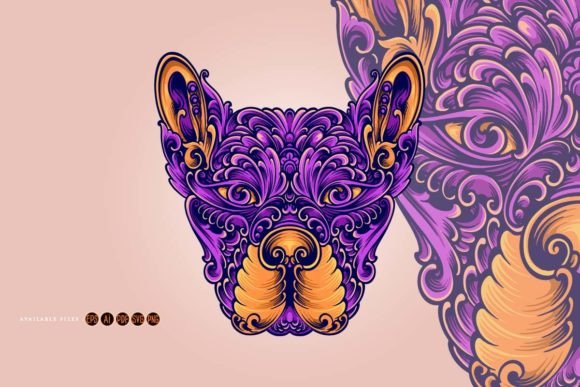
When Head Dog Vintage Ornament SVG opened on my screen, I didn’t see just another dog illustration—I saw a well-considered mood. It’s got that warm, slightly weathered charm of an old apothecary label or a hand-stamped holiday tag: clean lines, balanced negative space, and just enough detail to feel intentional—not fussy. The head-on profile gives it presence without aggression; the vintage treatment (subtle texture cues, restrained linework, no over-rendered fur) makes it feel at home on both rustic kitchen towels and minimalist baby onesies. This isn’t a design shouting for attention—it’s one that earns it through quiet cohesion.
Where It Lives Best: Real Projects, Not Just Pixels
I recently prepped a small-batch run of embroidered canvas tote bags for a local pet boutique—and Head Dog Vintage Ornament SVG was my top candidate. Why? Because it scales cleanly from 3” to 5” without losing legibility, holds up beautifully in satin stitch for crisp outlines, and reads clearly even when stitched on mid-weight natural canvas with light stabilizer. I also tested it as a center chest embroidery on organic cotton sweatshirts—no puckering, no thread nesting, and the vintage tone aligned perfectly with the shop’s “thoughtful handmade” branding.
It shines in contexts where authenticity matters: nursery decor (stitched onto a linen pillow cover), holiday gifts (a single ornament motif on a wool-blend tea towel), or personalized baby embroidery (paired with a soft monogram in running stitch). As an embroidery file, it avoids the trap of over-detail—no tiny eyes or whiskers that vanish into fill stitch noise. That means fewer re-hooping moments and more consistent finished product quality across your craft business.
Where to Pause—and Test Thoroughly
That said, Head Dog Vintage Ornament SVG isn’t universally forgiving. On highly textured fabrics like bouclé or thick terry cloth, the subtlety of its contours can blur—so I’d recommend simplifying stitch density or opting for a bold applique design instead. Thin or stretchy fabrics (think lightweight jersey tees or ribbed baby caps) need extra stabilization and possibly a slight outline reinforcement—especially around the ears and snout, where fine curves meet open space. And while it works on dark fabric, avoid low-contrast thread colors: a charcoal gray dog on navy feels muddy unless you lift it with off-white or cream thread.
Curved surfaces—like structured baseball caps—require careful placement. The shape’s symmetry helps, but I’d avoid stitching it too close to the bill curve unless you’re using a cap frame and reducing stitch density by 10–15%. Also, skip using it as a standalone motif on items meant for heavy laundering (like kids’ dish towels) unless you confirm the fill stitch coverage is dense enough to hold up—or consider reinforcing with a light backing stitch.
What It Adds to Your Craft Business (Beyond the Stitch)
For Etsy sellers and small shop owners, Head Dog Vintage Ornament SVG delivers quiet professionalism. It doesn’t scream “trendy”—which means it won’t date your listings next season. Customers recognize sincerity in handmade presentation, and this design supports that: it looks equally intentional on a $28 embroidered patch and a $95 linen apron. Its versatility across categories—tote bag design, sweatshirt embroidery, holiday embroidery, even printable mockups for digital product previews—means one purchase supports multiple revenue streams without visual whiplash.
More importantly, it builds trust. When buyers see consistent, well-executed embroidery on your photos—clean edges, balanced density, thoughtful thread choices—they assume the same care went into packaging, timing, and communication. That perceived reliability converts browsers into repeat buyers, especially in niches like pet lovers, vintage collectors, or slow-living lifestyle shoppers.
Practical Notes Every Embroidery Designer Should Run Through
- Always test first: Stitch Head Dog Vintage Ornament SVG on scrap fabric matching your final project’s weight, weave, and stretch—even if it’s “just canvas.”
- Check thread color contrast in both natural and artificial light. What reads well on screen may disappear on oatmeal linen.
- Review stitch density before sending to machine—especially if converting from vector to embroidery file. Overly dense fills can cause stiffness on baby items; too sparse risks fraying on high-wear edges.
- Confirm hoop size compatibility. Its proportions suit standard 4×4” hoops comfortably—but double-check if you’re using mini hoops or large-format frames.
- Inspect small details like ear tips and collar line: do they translate clearly in satin or fill stitch? If not, simplify manually before stitching.
- Test black-and-white mockups to gauge silhouette strength—this design relies on shape as much as texture.
- Compare light vs. dark backgrounds side-by-side. Its vintage tone gains warmth on cream but gains definition on charcoal.
- Use appropriate stabilizer: tear-away for stable wovens, cut-away for knits or lightweight fabrics.
- Verify licensing before selling finished items or reselling the digital file—this falls under Graphics, but commercial use terms vary by seller.
Final Thought: A Design That Works, Not Just Looks
Head Dog Vintage Ornament SVG isn’t flashy—but then, the best machine embroidery design rarely is. It’s the kind of illustration that disappears into your product just enough to feel native to it, while still carrying unmistakable character. Whether you’re stitching custom apparel for a local groomer, building a cohesive line of nursery decor, or creating limited-run patches for a craft fair, it adds polish without pretense. In a market flooded with overly complex or trend-chasing graphics, this one earns its place—not because it’s loud, but because it’s right. And for designers, small shop owners, and makers who value clarity, consistency, and real-world performance? That’s the highest compliment of all.